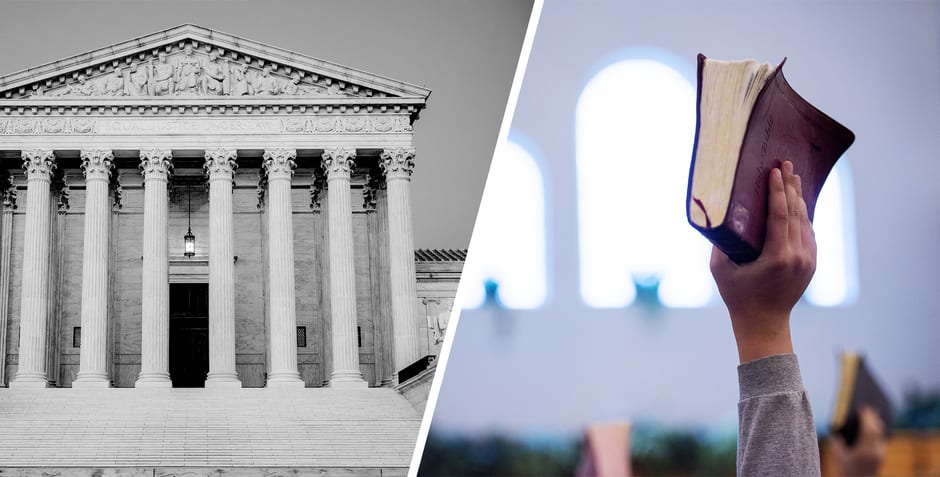
The Supreme Court Will Decide: Can a City Use Red Tape To Kill Your Bible Study?
Listen tothis article
The Supreme Court has agreed to hear one of the most consequential religious liberty cases in years – and the ACLJ has filed to make sure the Court gets it right.
Grand v. City of University Heights, Ohio asks a deceptively simple question with sweeping implications: Can a municipality shut down a small, home-based Jewish religious gathering through an escalating campaign of bureaucratic pressure, and then escape any federal accountability simply because it never issued a final, formal denial?
The Sixth Circuit said yes. We are asking the Supreme Court to say no. We filed in support of the cert petition, and now the high Court is taking and reviewing this important case on the merits.
Mr. Grand, a Jewish resident, sought a permit to host a small Jewish prayer quorum – a minyan – in his own home. Instead, he faced a campaign of governmental pressure: hostile hearings, demands for architectural drawings, escalating administrative requirements, and open hostility that made continuing the process untenable. When Mr. Grand, worn down and financially drained, withdrew his application, the Sixth Circuit didn’t blame the city. It blamed him – holding that he was “the author of any chilling effect on his First Amendment interests.”
That is exactly backward. Our brief identifies two independent errors, each serious enough on its own to warrant reversal. First, the Sixth Circuit borrowed a “finality requirement” from Williamson County – a Takings Clause case about calculating economic loss from property regulation – and grafted it onto a First Amendment and Religious Land Use and Institutionalized Persons Act (RLUIPA) claim.
But constitutional harm to religious exercise isn’t like a takings claim. When government pressure causes a reasonable person to cancel a prayer service or abandon a small-group Jewish gathering, the injury is complete the moment it happens. It doesn’t wait for a zoning board to finish its paperwork – and RLUIPA’s own text confirms Congress meant to address ongoing government conduct, not just final decisions.
Second, and just as troubling, this rule doesn’t burden everyone equally. Large, well-funded religious institutions with legal departments can absorb years of administrative proceedings to satisfy a finality requirement. The homeowner hosting a weekly prayer group cannot. Under the Sixth Circuit’s rule, the very smallness and informality that define home-based religious practice become the reasons it loses federal protection.
Our brief draws on the ACLJ’s own experience defending home-based worship across the country. We’ve seen it in Fairfax County, Virginia, where officials proposed crippling home Bible studies. We’ve seen it in Georgia, where a retired couple was told their home ministry violated zoning law. We’ve seen it in Manhattan Beach, California, where a resident was told he could host 100 people to watch The Lord of the Rings – but not to gather for worship.
In every one of these cases, the government backed down before ever issuing a “final decision.” Under the Sixth Circuit’s rule, none of these victims of religious discrimination would ever have had access to a federal courtroom – because the harassment stopped just short of a formal ruling. That result doesn’t protect religious liberty. It rewards municipalities for using process itself as the weapon.
This case is not just about one man’s Jewish prayer group in Ohio. Home-based religious gatherings – prayer quorums, Bible studies, fellowship groups – are central to how millions of Americans, across Jewish and Christian traditions alike, practice their faith. If the Sixth Circuit’s rule stands, any city hall in the country has a blueprint for shutting down a religious gathering: apply pressure, escalate demands, and never issue a final decision. No formal denial, no lawsuit, no accountability.
The ACLJ’s brief urges the Supreme Court to reverse the Sixth Circuit and restore RLUIPA’s true protections. We will keep fighting to ensure that no American has to choose between their faith and their front door.