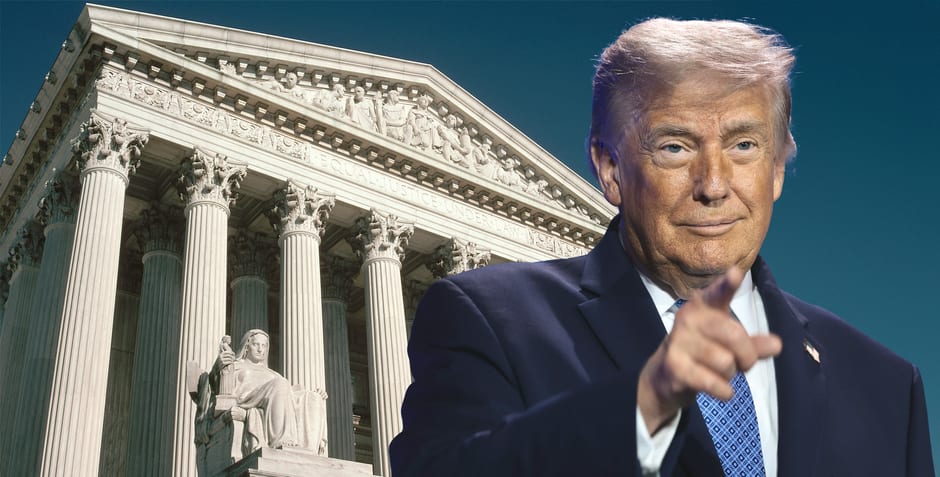
“You’re Fired” – A Major Win for President Trump and His Executive Power at Supreme Court
Listen tothis article
This week the Supreme Court gave President Trump – and the Constitution of the United States – a significant victory. In Trump v. Slaughter, the Court ruled that the President can remove Federal Trade Commission (FTC) Commissioner Rebecca Kelly Slaughter without jumping through extra legal hoops. More importantly, the Justices threw out a 1935 New Deal-era decision that had long restricted the President’s ability to oversee core parts of the Executive branch.
This is a big deal for how our government works, and a massive blow to the deep state. Our Constitution rests on the separation of powers. It puts the President in charge of executing the laws, which means he needs real authority over the people who carry them out. Congress cannot hamstring the President with special protections for officials who wield Executive power.
What the Court Said
The Federal Trade Commission, like countless federal agencies, wields immense power. It oversees dozens of regulatory schemes, investigates companies, brings enforcement actions, and issues rules that carry the force of law. These are core Executive functions. Under the Constitution, it is the President – the one official elected by the entire country – who should supervise and, when necessary, remove the people doing that work. Without that authority, important parts of government become unaccountable to the voters, run by unelected bureaucrats.
That’s exactly what happened here. Rebecca Slaughter, a Biden appointee known for advancing radical Left-wing priorities at the FTC, was removed by President Trump. He acted to fulfill his mandate from the American people and install commissioners aligned with his agenda. Chief Justice Roberts, writing for the 6-3 majority, made the point clearly: The Constitution creates a chain of command so the President can ensure the laws are faithfully executed. Old rules that shielded certain agency heads from removal got in the way of that basic structure.
This was a landmark decision. The Court overturned Humphrey’s Executor, the 1935 precedent that had allowed Congress to give FTC commissioners special job protections. The Justices concluded that keeping that precedent would have left vitally important parts of government unaccountable to the President. The modern FTC no longer resembles the limited agency the Court considered in 1935. Today it operates as a powerful enforcer, and the Constitution does not permit Congress to wall it off from presidential oversight.
The ACLJ’s Role
The ACLJ filed a friend-of-the-court brief supporting the President’s position. We argued that the Constitution gives the President authority over principal officers who exercise executive power. Shielding them from removal breaks the chain of accountability the Framers built into our system.
As our brief explained:
The President must be able to remove those who assist him in executing the law, or the Constitution becomes an empty promise and accountability to the people disappears.
We also pointed out that even if the 1935 decision made sense for the much smaller FTC of that era, it cannot control today’s powerful agency. The Court’s ruling tracks closely with the arguments we presented. By filing the brief, the ACLJ helped ensure the Justices had a clear constitutional road map for restoring the President’s rightful authority.
What This Means Going Forward
This ruling marks a major shift toward restoring presidential authority. No longer can Congress pass the buck to unelected bureaucrats at unaccountable agencies. When Congress creates an agency and gives it real power, the levers of that power belong to the people of the United States through their elected President. We expect these agencies to become more responsive to the President – and therefore more responsive to the voters who elected him. That’s how our constitutional system is supposed to work: Power flows from the people, through their elected President, to the officials carrying out the laws.
The decision will have ripple effects across the administrative state. Other independent agencies whose leaders perform core Executive work will now face the same constitutional reality. This does not eliminate expertise or bipartisanship – Presidents still appoint qualified people and statutory qualifications remain – but it does end the fiction that these officials can operate completely outside the President’s control.
The ACLJ is proud to have helped make the case for this commonsense constitutional result. The decision brings important parts of the government back in line with the structure the Founders designed – one where President Trump can lead the Executive branch and answer directly to the American people for how it performs.
After decades of courts allowing Congress to create pockets of power insulated from the elected President, the Supreme Court has restored a vital piece of constitutional order. The people’s choice for President can now more effectively direct the agencies that shape daily life in America.