Weakness Leads to War or Servitude
The Biden Administration continues to project weakness abroad, and the consequences are severe—and the ultimate impact alarmingly unpredictable. We know some of the results of empty bluster and feckless diplomacy. But we actually do not know how deep, dangerous, and lasting the consequences are of signaling weakness instead of strength. Nowhere is this more evident than with our responses to China.
The United States continues to be dependent on goods and products from the Communist nation. It is bad enough that useful products come daily from China—products that a generation ago were made in America. However, we also continue to depend on China for critical medical supplies and equipment, as well as life-saving pharmaceuticals. China is laying claim to rare-earth minerals upon which we all depend. Our push for renewable/solar energy enriches the Chinese Communist Party (CCP). Our phones and vast amounts of other electronic equipment are shipped from a country that is carte-blanche controlled by the CCP. The list could go on and on.
U.S. corporations look the other way concerning the national security threat this poses. Sadly, these same companies look the other way regarding how much of the goods produced in China are made with slave labor. No wonder the products are less expensive, and China continues its quest to dominate the world markets on just about everything. The Chinese system of producing and exporting goods is immoral—and everyone knows it. But nothing is being done to stand against Chinese practices, and virtually nothing is being done to bring manufacturing back to the United States.
China’s President Xi is using his nation’s resources and profits to build the world’s largest military. While not quite as sophisticated and lethal yet, China’s navy is already larger than that of the United States. China has a standing army of over 3 million troops and an additional 510,000 reserve forces. China develops weapons and weapon platforms that rival those of the United States Armed Forces. A since-declassified congressional report cites a Defense Science Board finding that Chinese spying and cyber-attacks resulted in the theft of numerous U.S. weapons systems. This is why, for example, China’s latest jet fighter is practically identical to the F-35 of the U.S. Air Force.
The response of President Biden, and the Defense Department under his command, is baffling. For example, the Administration allowed the Chinese spy balloon to traverse the entire continental United States—including hovering over sensitive U.S. military sites—before finally shooting it down. The Biden Administration at first adamantly denied that the balloon was communicating in real time with its Communist handlers—only to finally admit that it was. The Biden team denied—and now confesses—that China is building a base in Cuba (90 miles from the U.S. mainland) for the purpose of spying on the United States. China is negotiating with Cuba’s communists about establishing permanent military bases on the island and paying billions of dollars to the Cuban government.
China’s response to its activities and plans in Cuba is that the U.S. is doing something similar by arming Taiwan. There is a huge difference: The U.S. is not planning on invading Cuba. China continues to state that it will use military force to make Taiwan a part of China. Chinese aircraft and naval forces routinely violate the sovereign airspace and waters of Taiwan.
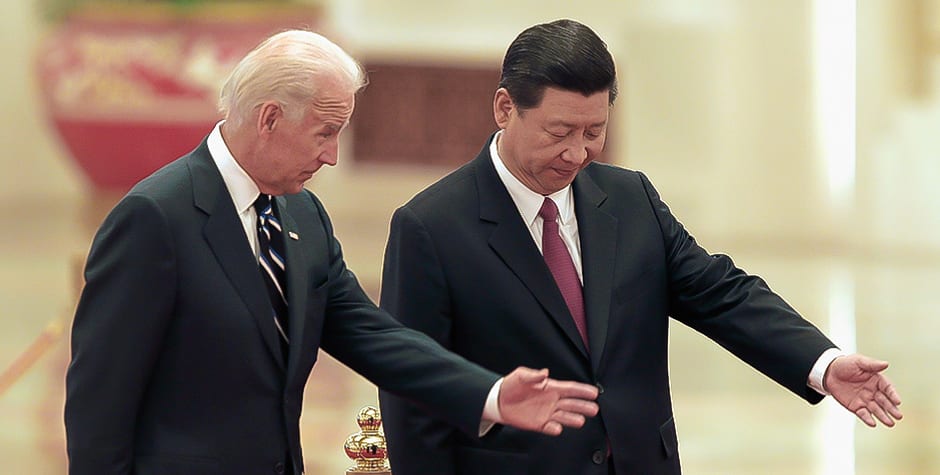
Yet President Biden downplays China’s malevolent activities. Speaking of the spy balloon, Biden declared it was not a big deal and that it was more of an “embarrassment” to President Xi than anything else. The U.S. had every right to call foul on the spy craft and to pull back from our relationship with China. In fact, the reverse happened. China was indignant that we destroyed the balloon and has refused to speak with U.S. diplomats and Defense Department officials since the incident. So cue up the Biden Administration sending Secretary of State Antony Blinken to Beijing recently, hat in hand, to try and mend a relationship that China damaged. By the way, while there (in order to placate the Communist regime), Blinken declared that the U.S. does not support Taiwan as an independent nation.
Weakness invites aggression. It is a truth sadly not recognized by the Biden Administration. The go-to response by Biden to any adversaries of the U.S. is to speak softly and carry no stick—or to use bluster and anger and do nothing else. President Biden really is weak on national security and soft on our enemies—and the question is “Why?” The Biden White House, for example, is now sending $17 billion to Iran. Iran is producing weapons that Russia is using to kill people in Ukraine, where the U.S. is in a proxy war. Iran is also on the verge of producing a nuclear weapon.
The Biden Administration seems incapable of taking a strong and consistent stance against our enemies—including China, Russia, and Iran. Or perhaps the Biden White House is merely unwilling to take a stand. But that puts the United States at risk. Our reputation is at risk among our allies and our enemies. Our economy is at risk due to the theft and financial policies of the CCP. The safety of the Middle East and the world is at risk due to the dark intentions of Iran. Our towns and cities are at risk due to Biden’s open border policies. The American people struggle because our energy independence is not only at risk but also has been obliterated by the policies of Joe Biden, who appears clueless as to the second- and third-order effects of his actions.
Most of all, the national security of the United States is at risk. The weakness, vacillation in foreign policy, and world outlook of the Biden team can actually lead to a war that no one in America wants. Either that, or we enter a period of de facto servitude to the nations who wish us harm, and the weakness only worsens. The American people deserve better and must demand better.
Support the work of the ACLJ as we continue to bring you expert analysis and legal action on the issues that matter most.