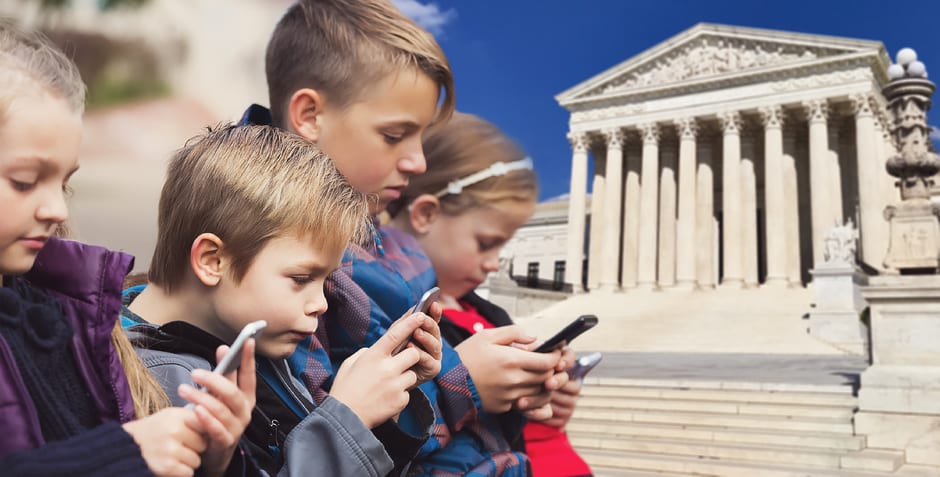
ACLJ Urges Supreme Court To Let Texas Protect Parents’ Rights and Children Online
Listen tothis article
The ACLJ has once again stepped into a critical battle over parental rights, free speech, and the protection of children in the digital age.
This week, the ACLJ filed an amicus brief at the U.S. Supreme Court urging the Court to reject emergency requests seeking to block Texas’ App Store Accountability Act, Senate Bill 2420 (SB 2420), a landmark law designed to restore parental control over minors’ access to mobile apps.
This is not the ACLJ’s first involvement in this critical case. Earlier this year, we filed an amicus brief in the U.S. Court of Appeals for the Fifth Circuit defending Texas’ App Store Accountability Act and urging the court to uphold the state’s efforts to restore parental authority in the digital age. The Fifth Circuit ultimately stayed the district court’s injunction and allowed the law to take effect while the appeal proceeds. Now, as opponents ask the U.S. Supreme Court to intervene and halt the law, the ACLJ has again entered the case to defend the constitutional rights of parents and the authority of states to protect children online.
A Commonsense Law That Empowers Parents
Texas enacted SB 2420 to address a growing reality: Children today can access countless apps, social media platforms, online communities, and digital marketplaces with little or no parental knowledge or involvement.
The law requires app stores to:
- Verify a user’s age through commercially reasonable methods.
- Classify accounts as adult or minor accounts.
- Obtain parental consent before minors download apps.
- Obtain parental consent before minors make in-app purchases.
Importantly, the law does not ban content, censor speech, or restrict adults’ access to apps. Instead, it places parents back in the role that they have traditionally occupied for generations – making decisions for their minor children.
Our Core Argument: Parents Should Decide
In our Supreme Court brief, we argued that SB 2420 is firmly grounded in longstanding constitutional principles recognizing parents’ fundamental right to direct the upbringing and education of their children. The Court has repeatedly affirmed protections for parental rights in landmark decisions such as Meyer v. Nebraska, Pierce v. Society of Sisters, Troxel v. Granville, and Parham v. J.R.
The central question in this case is simple: Who decides what online platforms and applications a child may access?
Our answer is equally as simple: Parents.
SB 2420 gives parents the tools necessary to exercise their constitutional authority in a digital environment where technology has increasingly circumvented traditional parental oversight. As our brief explains, the law channels decision-making authority to parents rather than legislators, bureaucrats, or technology companies.
Opponents of the law have attempted to characterize SB 2420 as a restriction on speech, but we explained why that characterization misses the mark – because it is a contracts issue.
Downloading apps often involves entering into license agreements, accepting terms of service, creating commercial relationships, sharing personal information, and engaging in financial transactions through in-app purchases. These are contractual undertakings.
For generations, states have recognized that minors generally lack the legal capacity to enter binding contracts without parental involvement. Texas law follows that longstanding tradition. We argue that SB 2420 simply applies those familiar protections to the modern digital marketplace.
States routinely require parental consent for minors in numerous contexts, including medical treatment, financial accounts, marriage, vehicle licenses, and military enlistment. The digital economy should not be treated differently simply because the transactions occur through a smartphone rather than in person.
Protecting Children From Documented Digital Harms
Our brief also addresses the growing evidence showing serious harms associated with unrestricted access to apps and social media platforms.
Children today face increasing risks from:
- Anxiety and depression
- Suicidal ideation
- Addictive app design
- Cyberbullying
- Exposure to inappropriate content
- Contact with predators and drug dealers
- Exploitative data collection practices
We cannot just sit back and continue allowing this to happen – parents must be supported in their efforts to end these harms for their kids.
As our brief notes, modern technology has largely eliminated the natural parental checkpoints that once existed between minors and potentially harmful online activity. SB 2420 helps restore those checkpoints by requiring parental involvement before app downloads and purchases occur, supporting parental authority.
For decades, the ACLJ has been a leading advocate before the Supreme Court and courts across the country on issues involving constitutional liberties, free speech, and parental rights. This case sits at the intersection of all three.
The main point is simple: Parents retain the primary responsibility for raising their children. States have a compelling interest in supporting parents as they fulfill that responsibility. And courts should be cautious before preventing states from providing parents with tools to protect their children online.
That is why the ACLJ has stood with Texas from the Fifth Circuit through the current proceedings before the United States Supreme Court. Stand with us as we argue that parents – not Big Tech companies and not government officials – should make decisions about their children’s digital lives.