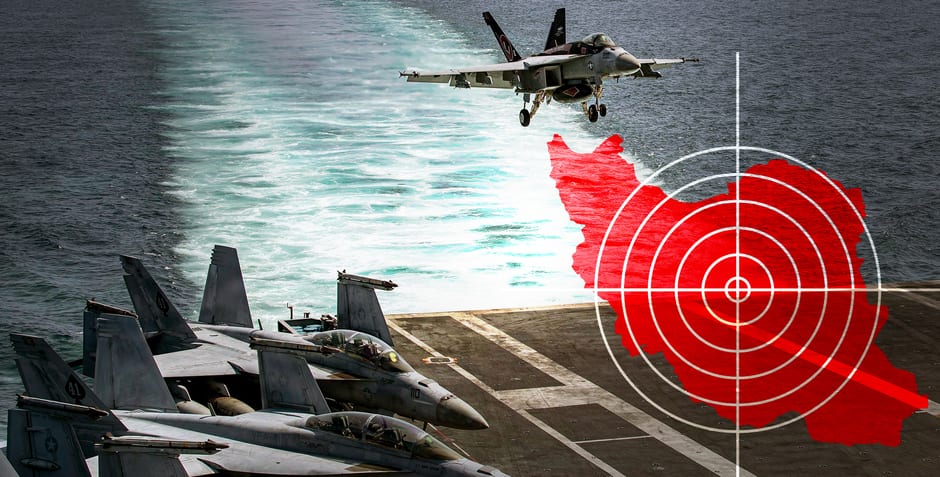
Peace Through Strength: Why Targeting Iran’s War Machine Is Both Lawful and Necessary
Listen tothis article
For decades, the radical regime in Tehran has operated under the delusion that it can sow chaos across the Middle East, out-negotiate the United States, fund global terrorism, and pursue nuclear ambitions without facing real consequences. Under the decisive leadership of President Trump, that era of ignoring the problem and the 47 years of Iranian war against the world has come to an end.
The recent limited strikes against Iranian infrastructure – power plants and bridges – (along with the threat of expanded strikes) have predictably sent the “blame America first” crowd into a frenzy. They’re throwing around the term “war crime” with the same recklessness they bring to any discussion of American power. Let me be direct: They’re wrong on the law, and they’re wrong on the strategy.
The foundational principle of the Law of Armed Conflict is distinction – the obligation to differentiate between purely civilian objects and legitimate military objectives. But the modern battlefield doesn’t offer clean lines.
Power grids and transport bridges are textbook dual-use targets. The same electricity that lights homes in Tehran also powers centrifuges at Natanz and the command centers of the Islamic Revolutionary Guard Corps (IRGC). The same bridges that carry commerce carry ballistic missiles aimed at our allies and at the Strait of Hormuz.
Under international law, when a facility makes an effective contribution to military action, it loses its protected status and becomes a lawful military objective. Degrading Iran’s ability to move its forces and power its war machine is not an attack on the Iranian people – it is the dismantling of the tools their oppressors use against them.
The United States military is the most ethical fighting force in the history of the world. Unlike the IRGC – which hides behind its own civilians and targets international shipping without a second thought – our commanders operate under rigorous rules of engagement. I have complete confidence that the men and women executing these missions are in full compliance with the laws of armed conflict. Every target is vetted. Every strike is tied to a specific strategic effect.
Those shocked by the targeting of industrial infrastructure need to brush up on their history. This is not some radical departure from international norms. It is a proven method – one that has ended conflicts and saved lives.
During the Kosovo campaign in the late 1990s, NATO forces – backed enthusiastically by many of today’s loudest critics – struck the power grid in Belgrade to break Milosevic’s command and control. In World War II, we didn’t limit ourselves to tanks on the front lines. We hit the ball-bearing factories in Schweinfurt and the oil refineries that kept the Nazi war machine running, because we understood that you cannot defeat an aggressor while leaving its industrial heart intact.
The international community recognized both times that striking the nervous system of a hostile state is not only legal – it is necessary.
The Iranian regime has been at war with the West since 1979. For nearly 50 years, they have used their infrastructure to export violence and instability. President Trump is sending a message that cannot be misread – to Tehran, and to every other regime calculating whether America has the will to act.
We want a world where the Iranian people are free, and their neighbors are secure. That world is not built by coddling tyrants or pretending their logistics don’t matter. It is built through moral clarity, sound legal footing, and the unapologetic application of American power.