Justice Clarence Thomas and the Enduring Creed of the Declaration of Independence
Listen tothis article
This year, the Supreme Court has once again delivered landmark decisions safeguarding constitutional liberties, strengthening religious freedom, protecting free speech, and reaffirming limits on government power.
The ACLJ has been proud to stand at the forefront – filing critical friend-of-the-court briefs, defending faith-based institutions, and battling regulatory overreach and ideological mandates. Through strategic litigation and unwavering commitment, the ACLJ continues to help shape a judiciary that honors the Constitution rather than rewrites it.
It is fitting, then, that as we mark the 250th anniversary of the Declaration of Independence, one of the Court’s most steadfast constitutionalists reflected deeply on the document that launched our nation.
Take action with the ACLJ. Sign the petition: Defeat the Left’s War on Freedom.
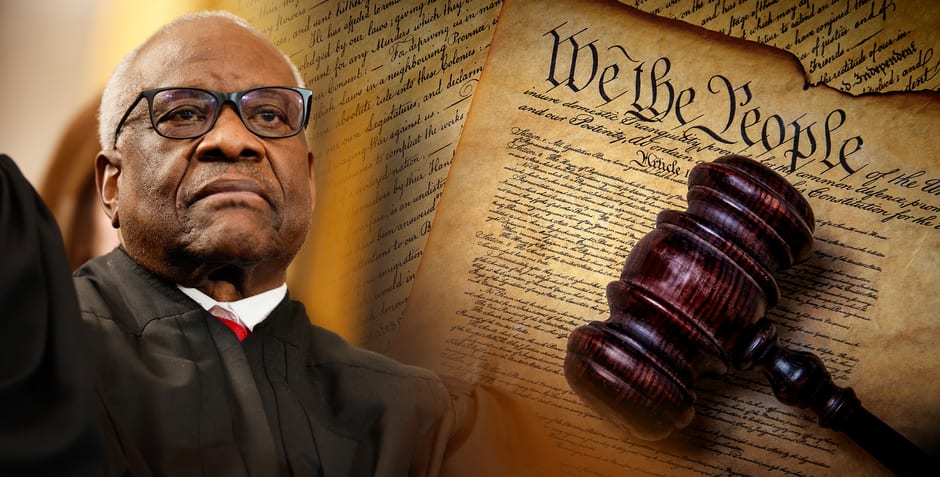
Last week, Supreme Court Associate Justice Clarence Thomas delivered a powerful address at the University of Texas at Austin. In clear, unflinching terms, he celebrated the Declaration’s core promise: that all men are created equal, endowed by their Creator with unalienable rights to life, liberty, and the pursuit of happiness.
Thomas drew from history’s darkest chapters – slavery, Jim Crow, eugenics, Nazism, and communism – to show how deviations from these principles cause profound human suffering. He praised Justice John Marshall Harlan’s lone dissent in Plessy v. Ferguson and lamented the Court’s earlier failure to uphold the color-blind ideal of equality before the law. Raised under segregation, Thomas spoke from lived experience: The Declaration’s truths were instilled in him by family, church, and community as convictions about human dignity that supplied the moral force to confront injustice.
At the heart of his remarks stood a robust defense of the American founding against a rival philosophy that emerged in the early 20th century: progressivism. As Thomas explained:
Progressivism seeks to replace the basic premises of the Declaration of Independence, and hence our form of government. It holds that our rights and our dignities come not from God, but from the Government. It requires of the people a subservience and weakness incompatible with a Constitution premised on the transcendent origin of our rights.
He pointed to Woodrow Wilson and 20th-century contemporaries like John Dewey, who dismissed fixed natural rights as “nonsense” and viewed government as an organic instrument for expert regulation rather than limited by mechanical checks and balances. This shift elevated the state as the source of rights and dignity – a view fundamentally at odds with the Declaration.
Thomas warned that such ideas carry real consequences. When rights derive from government rather than our Creator, they become negotiable and revocable. In contrast, the Declaration anchors human equality and liberty in permanent, universal truths that transcend race, class, or circumstance. America is a nation defined by our fidelity to self-evident propositions about human nature and legitimate government. Those principles proved powerful enough to end slavery and segregation. They continue to inspire the oppressed worldwide.
Predictably, some progressive voices reacted with outrage, accusing Thomas of bad history for noting early progressivism’s links to troubling currents like eugenics. Yet the deeper point endures: When government supplants the Creator as the granter of rights, the logic of limited, consent-based rule erodes.
History reveals the dangers of unchecked state power pursued in the name of “progress.” As Justice Thomas observed, progressives might critique America as backward or outdated in our government, but the results speak for themselves:
[W]e were fortunate not to trade our Lockean bounds for the supposedly enlightened world of Hegel, Marx, and their followers. Fascism – which, after all, was a national socialism – triggered wars in Europe and Asia that killed tens of millions. The socialism of the Soviet Union and the People’s Republic of China proceeded to kill . . . tens of millions of their own people. This is what happens when natural rights give way to the higher good of notions of history, progress, or, as Thomas Sowell has written, the “vision of the anointed.”
The Declaration is not window dressing. It is the mission statement. The Constitution serves as the operating manual – securing those ends through separation of powers, federalism, and protections for individual liberty.
Thomas closed by recalling the signers’ courage: Their mutual pledge of “our Lives, our Fortunes, and our Sacred Honor” with firm reliance on divine Providence. That spirit of principled commitment, tempered by constitutional restraint, remains the model for citizens today.
In an era of deep polarization, Justice Thomas’s address offers a model of intellectual honesty and patriotic clarity. He calls us to rediscover the Declaration not as a relic, but as a living charter of human dignity and self-government. By rooting rights in the Creator rather than the state, it elevates every person – regardless of background – while constraining government to its proper role.
At the ACLJ, we see this truth lived out daily in our work defending religious liberty, free speech, the right to life, and constitutional limits on government. As we commemorate America’s 250th anniversary, Justice Thomas’ words remind us why our mission matters: to protect the God-given rights enshrined in the Declaration and secured by the Constitution. Through strategic advocacy and litigation, the ACLJ will continue standing firm for these first principles like the Founders did, “with a firm reliance on the protection of Divine Providence,” – so that future generations may inherit the freest, most just society in history. That is the creed worth defending.
Take action with the ACLJ. Sign the petition: Defeat the Left’s War on Freedom.