Israel Defends Against Indiscriminate Rocket Attacks—AGAIN
While U.N. Special Rapporteurs claim that Israel does not have a right to defend itself against Palestinian attacks and the U.N.’s so-called “independent” inquiry commissions claim that Israel is in violation of international law by discriminating against Palestinians for taking security measures, Israel once again must respond to indiscriminate rocket and mortar attacks from Palestinian terrorist groups to protect its civilian population.
The groups attacking Israel reject its very right to exist. If it were not for the Iron Dome defense system, bomb shelters, and Israel’s other measures to protect its civilian population (which includes both Jews and Arabs), Israel’s situation would be considerably more precarious than it is. However, as has happened numerous times in the past, once again, the people who condemn Israeli responses simply disregard this reality and jump to unfounded conclusions, alleging that Israel has violated international law.
The reason for the current operation is a series of indiscriminate rocket attacks from Gaza after a former spokesman of the Palestinian Islamic Jihad (PIJ) died in Israeli custody. Khader Adnan, the PIJ spokesman, was on a hunger strike, protesting his detention while awaiting prosecution for membership in a terror organization and incitement to terrorism. Adnan, who was born in Jenin, in the West Bank, “had been in and out of prison for more than two decades [for his involvement in terrorism] and had used hunger strikes to protest against his arrests.” Moreover, Israeli authorities were not the only ones who had arrested him. He had also been arrested by the Palestinian Authority (PA) for leading protests in 1999.
What’s also important to note is that Adnan died due to his hunger strike, not due to any refusal by the Israelis to provide him food or adequate medical treatment. During his 86-day hunger strike, Israelis even allowed medics from the Physicians for Human Rights in Israel to visit Adnan in prison. The medics warned that he faced imminent death, but Adnan refused medical tests and treatment by Israeli authorities. Because the Jewish people had been subjected to forced “medical treatment” during the Third Reich, Israel is very sensitive to forcing a medical procedure on anyone, a fact well-known by the Palestinians.
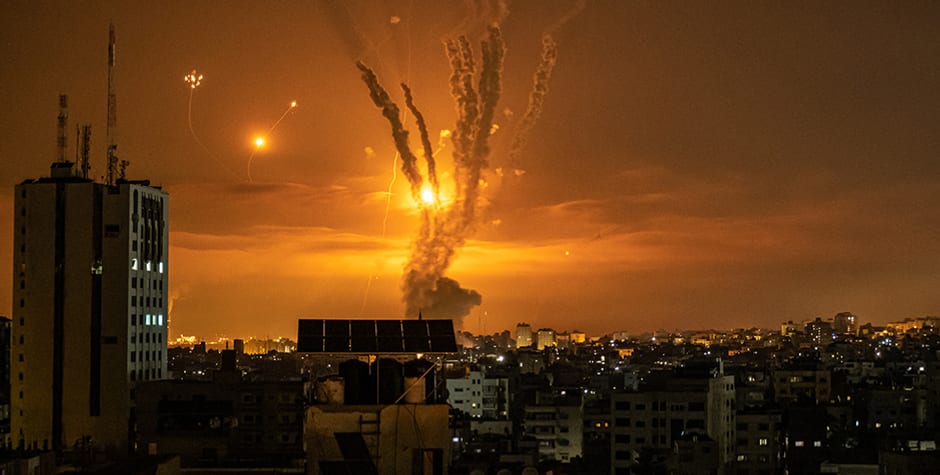
Blaming Israel for Adnan’s death, the PIJ fired scores of rockets from Gaza into southern Israel. Some of the rockets indiscriminately directed at Israel’s civilian population centers were intercepted by the Iron Dome, and others fell on open ground. Israel’s critics conveniently forget such attacks and only focus on Israel’s response, claiming that Israel violated the Law of Armed Conflict, also called international humanitarian law.
The U.N. Special Rapporteurs and inquiry commissions fail to recognize that each indiscriminate rocket attack in retaliation for Adnan’s death violated the Law of Armed Conflict. Instead, they only focus on Israeli actions and Palestinian casualties.
The response from the PIJ to avenge Adnan’s death violated the Law of Armed Conflict in at least two distinct ways. A military response in an armed conflict must conform to the principles of distinction and proportionality. The PIJ’s attack violated both.
First, the Law of Armed Conflict prohibits targeting civilians if they are not participating in hostilities. Even in a commingled battlefield, where both military objectives and civilian objects are present, the rule requires distinguishing between military objectives and civilian objects and taking every precautionary measure to avoid civilian casualties. The rocket attacks from Gaza constituted a war crime because they were indiscriminately fired at civilian locations—i.e., civilians were the target. Second, a military response in an armed conflict must be proportional. Firing dozens of rockets in anger and revenge toward a civilian population does not comply with the principle of proportionality. But Israel’s critics don’t care about that.
In response to the scores of indiscriminate rocket and mortar attacks that occurred after Adnan’s death, on Tuesday, May 9, Israel carried out a precision “20-second strike” to take out three senior members of the PIJ, all of whom were involved in planning attacks on Israeli soil. Because it is the modus operandi of groups like the PIJ and Hamas to carry out their terrorist activities from civilian areas, using Palestinian civilians as human shields (another war crime), the Israeli strike inadvertently resulted in some civilian casualties (tragic, but not a war crime).
Contrary to the outlandish claims that Israel does not have the right to self-defense against Palestinian attacks, every State (including Israel) has a right to defend itself, regardless of the identity of the attacker. This is an inherent and inalienable right, which is also codified in the U.N. Charter. Further, the presence of civilians or civilian objects in the proximity of military objectives does not immunize those objectives from attack. This is especially true when a belligerent (like the PIJ and Hamas) deliberately locates military objectives in proximity to civilians, which in itself is a separate war crime. As such, a belligerent who deliberately locates military objectives in proximity to civilians or civilian objects shares responsibility for any harm to those civilians resulting from a legitimate enemy attack on those military objectives.
Any civilian casualty is regrettable, no matter who the victim is. However, it is clear that incidental death or injury to civilians or civilian property in armed conflict is an unfortunate but legally accepted reality. A commander does not violate the law when he orders an attack with the knowledge that civilians will likely become collateral casualties of the attack, so long as he does not act with the purpose (conscious objective) to cause such casualties or knowledge that the casualties will be excessive in relation to the anticipated military advantage.
The assessment of the strike’s lawfulness involves a complex legal analysis, which must take the circumstances and decisions made at the time of the attack into consideration. As mentioned above, the fact that civilian casualties occur does not ipso facto render the strike unlawful, while indiscriminately firing rockets to deliberately target civilians without any military objective is a war crime.
Who were the targets of the Israeli air strike, code-named Operation Shield and Arrow? They were three prominent leaders of the PIJ, a group funded by Iran and known for its open call to destroy Israel and to remove it from the Middle East map. The PIJ also “refuses to negotiate or engage in the diplomatic process” but instead advocates and carries out violence.
One of the three leaders killed in the Israeli strike was Jihad Ghanem, who orchestrated the murders of Tali Hatuel, a pregnant Israeli mother, and her four daughters in Gaza. Ghanem was “the secretary of PIJ’s military council . . . [,] oversaw the transfer of funds between the PIJ and Hamas,” and promoted terrorism in Israel. The second man, Khalil Bahtini, was “the PIJ commander for the northern Gaza Strip and was planning imminent terror attacks in Israel.” He also “promoted suicide attacks, bombings, and rocket fire in Israel.” The third man, Tareq Izzeldeen, was the PIJ’s “intermediary between its Gaza and West Bank members for the transfer of terror funds.” The three men were legitimate military targets, not innocent civilians. Because these men had been acting for years in advocating and carrying out violence against the Israeli civilian population, killing them provided a direct and concrete military advantage to Israel. IDF chief, Herzi Halevi, stated: “If it had been possible to target the three terror commanders without harming noncombatants, . . . then the IDF would of course have done so.” This was not just a political statement. The IDF indeed takes every precautionary measure to avoid civilian casualties.
After the Israeli strike, in retaliation, the Palestinian armed groups fired over 270 rockets toward Israel, targeting southern Israel, including the Tel Aviv area, Beersheba, Sderot, and Ashkelon. The rockets were also intercepted by David’s Sling, a new missile defense system deployed in addition to the Iron Dome. In response, Israel launched more strikes, attacking PIJ infrastructure in Gaza. Again, those who condemn Israel will disregard that Israel is responding to these attacks. Instead of condemning the PIJ’s indiscriminate attacks, which clearly constitute war crimes, they will blame Israel for simply trying to defend itself.
At the ACLJ, we stand with Israel and will never stop defending our ally. Even when the international community turns against Israel, we will advocate on its behalf and fight to preserve a secure State of Israel.