Iran and Israel: What Was the Biden-Harris Admin Thinking?
Listen tothis article
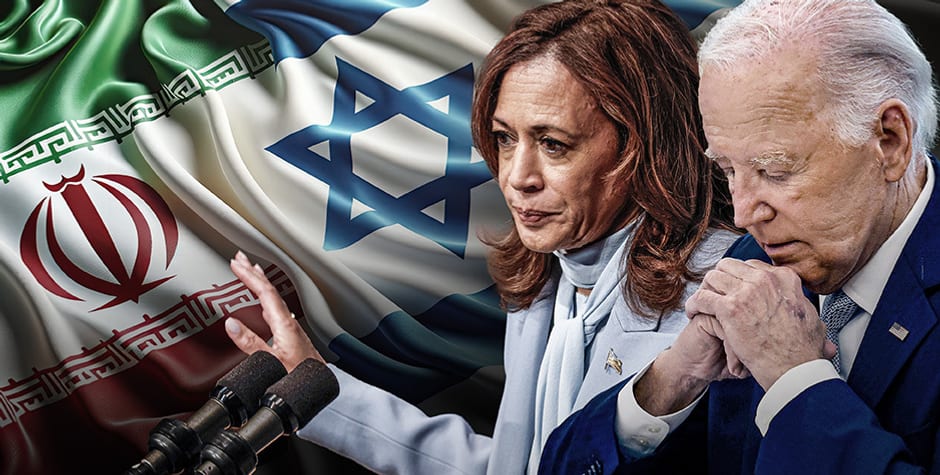
Years from now, historians will look back at these past four years and wonder what in the world the Biden-Harris administration was thinking with its Iran policy. This administration has supercharged one of America’s chief adversaries, allowing it to project power across the most important region in the world to global energy security, threaten America’s key allies, and even impact conflicts far from its borders to America’s detriment. Worst of all, all of this could have been avoided if America’s leaders had simply stayed the course towards peace set by the Trump administration.
Over this past weekend, Houthi rebels fired a missile from Yemen into central Israel. It traveled deeper into Israel than any prior missile launched at the Jewish state by the terrorist group, and it somehow evaded Israel’s Iron Dome – fortunately, though, no Israelis were injured. The Houthis claimed the missile was ‘hypersonic,’ meaning it could travel faster than the speed of sound and therefore evade Israel’s missile defense systems. While the Pentagon has refuted this claim, this is still yet another alarming attack – among many – on our ally that was made possible by the Biden-Harris administration’s backwards approach to Iran and the broader Middle East.
Let’s consider where things stood only four years ago. The Iranian regime was practically bankrupt due to the Trump administration’s sanctions, and our efforts toward peace in the region had finally disproven the myth that Israel could never seek normal, peaceful relations with its neighbors without acquiescing to Palestinian terror. By helping forge the Abraham Accords – a set of new diplomatic and economic relationships between the Jewish state and its Arab neighbors – while deepening our own security cooperation with the Gulf nations and Saudi Arabia, we put Iran in a box, and in so doing we cut off the vital source of power that fueled its proxies, from Hamas, to Hezbollah, to the Houthis, and militias across Iraq and Syria. This was good for Israel, good for the world, and, most importantly, it was good for the United States.
Four years later, the situation could not be more different. There is more to say than room to write: the Biden-Harris administration resumed foolish Obama-era negotiations with Iran, chose not to enforce American sanctions on Iranian oil, paid out billions of dollars in ransom money to the Iranian regime, removed the terrorist designation from the Houthis, resumed UNWRA payments that enriched Hamas, and so much more. As we near the end of the Biden-Harris administration’s tenure, it is staggering to see the full scope of what its backwards Middle East policy has wrought.
The costs have been enormous. You can draw a straight line from the administration’s failed policies and the gross, barbaric Hamas attacks on October 7th. The Houthis have now successfully disrupted global commercial shipping through the Red Sea for months, something only possible with Iranian support and direction, while the Biden administration’s efforts to cobble together a multinational coalition to secure the passage has failed. What an indictment of this administration’s failed leadership: it cannot even lead an effort to successfully dislodge a terrorist organization from a vital artery of global commercial shipping.
Iran’s malfeasance has even spread beyond the region. It has been a prime, vital supplier of drones, missiles, and munitions for Vladimir Putin’s war machine in his invasion of Ukraine, and in return, it seems that Putin has been helping Iran achieve its dreams of developing a nuclear weapon. Reports from the Pentagon last week confirmed that Iran had “transferred shipments of Fath 360 close-range ballistic missiles to Russia.” These missiles will undoubtedly be used to inflict even more casualties on Ukrainian civilians.
Could the Iranian regime have hoped to do any of this when their economy was choked by efficient and ruthless American sanctions? Of course not. This is the cost of failed American leadership: Our allies and partners suffer, the world becomes less stable, and Americans at home and abroad are put at greater risk. This November, Americans have a choice: continue down this same path by electing the same failed leadership, or vote for a strong America capable of deterring our adversaries.