School Bans Pro-Life Club Over “Defund Planned Parenthood” Flyer – ACLJ Takes Fight to Supreme Court
Listen tothis article
Too many public high schools have become petrie dishes for far-Left activism, where school administrators act as ideological “bouncers” – deciding which ideas get to stay and which ones are thrown out. That’s exactly what happened to an after-school Students for Life club in Indiana when it was ultimately banned.
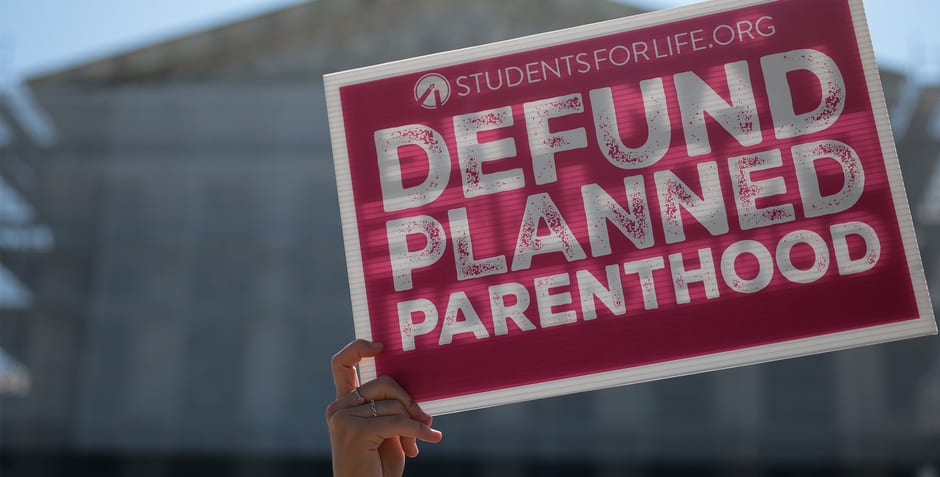
The club designed a flyer featuring students holding signs reading “Defund Planned Parenthood.” After receiving administrative sign-off, it was posted on a school bulletin board alongside flyers for dozens of other student groups – and you can probably see where this is going.
Despite allowing more than 70 non-curricular, student-initiated clubs, including politically oriented groups, the Noblesville School District suddenly decided that advocating for defunding Planned Parenthood was the one “political” message that crossed a line. School administrators barred the flyers and then outrageously took it a step further, pulling the Students for Life club’s official recognition – silencing the group entirely.
That decision reflects a troubling trend: Pro-life students are increasingly targeted for expressing views that are constitutionally protected.
The ACLJ has now filed an amicus brief urging the U.S. Supreme Court to step in.
Take action with the ACLJ. Add your name to the petition: Defeat the Left’s War on Freedom.
What’s at Stake
The Seventh Circuit Court of Appeals applied the so-called “imprimatur” test from Hazelwood School District v. Kuhlmeier (1988), asking whether a hypothetical observer might perceive the poster as bearing the school’s stamp of approval. Based largely on that perception, the court allowed the school’s censorship to stand. But that makes no sense. How would anyone confuse a school club poster with the school’s “official” position?
The truth is that this is a common tactic to silence unwanted voices. We believe that reasoning is constitutionally dangerous – and the Supreme Court should say so.
The Same Flawed Game, a Different Board
For decades, the progressive wing of the courts used decisions like Lemon v. Kurtzman and the “reasonable observer” test it spawned to remove religion from every corner of the public square. For decades, courts asked whether a “hypothetical bystander” might feel that the government was endorsing religion. The results were inconsistent, unpredictable, and unjust, and largely reflected the judges’ own predispositions. After a long trail of victories for common sense confining this dangerous legal doctrine, such as the ACLJ victories in Board of Education v. Mergens and Summum v. Pleasant Grove, the Supreme Court finally laid Lemon to rest in Kennedy v. Bremerton School District(2022).
When the ACLJ fought, and won, to protect a Christian club’s free speech and free association rights at a public school, the Supreme Court made it clear: “[T]here is a crucial difference between government speech endorsing religion, which the Establishment Clause forbids, and private speech endorsing religion, which the Free Speech and Free Exercise Clauses protect.” (Emphasis added.)
Despite this victory in the world of freedom of religious exercise, the Seventh Circuit is playing that same game again – this time suppressing pro-life student expression. In our brief, we argue that Kuhlmeier’s “imprimatur” test, when extended far beyond its original context, creates the exact same problem: A fictional bystander effectively holds a veto over students’ First Amendment rights.
The Facts Are Clear
The school in this case did not write the student’s poster. It did not design it, edit it, or direct its message. The school’s own principal acknowledged that student interest clubs are “100% student driven.” The poster approval process had no written content standards and involved no meaningful editorial judgment whatsoever. That should have been the end of the question: Students, especially students fighting for preborn life, do not shed their freedom of speech at the schoolhouse gate.
By every measure this Court has established – history, government control, and editorial discretion – these posters are private speech. The Supreme Court made this framework clear in Summum, Matal, and Shurtleff. The right question is not “Could a passerby think the school is speaking?” The right question is “Is a student actually speaking?” Here, plainly, students were speaking until they were silenced.
Why We Filed
This case represents the logical endpoint of what the abortion lobby and powerful teachers’ unions have been pushing for years: a school environment where only one side of the debate is allowed to speak. Students can skip class to protest ICE, stage disruptive demonstrations on campus, and administrators look the other way – even facilitate it. But when a student posts a flyer calling to defund Planned Parenthood – suddenly the line has been crossed, and the club is banned. The First Amendment cannot operate on that kind of double standard.
The ACLJ has defended student religious freedom before this Court before – and we’re not stopping. Our brief urges the Supreme Court to uphold the legacy of ACLJ victories like Mergens and to tell radical courts that they must protect the free speech of students. The ACLJ will not allow pro-life students’ speech to be undermined by legal doctrines that open the door to indoctrinating public school administrators’ censorship.
Take action with the ACLJ. Add your name to the petition: Defeat the Left’s War on Freedom.