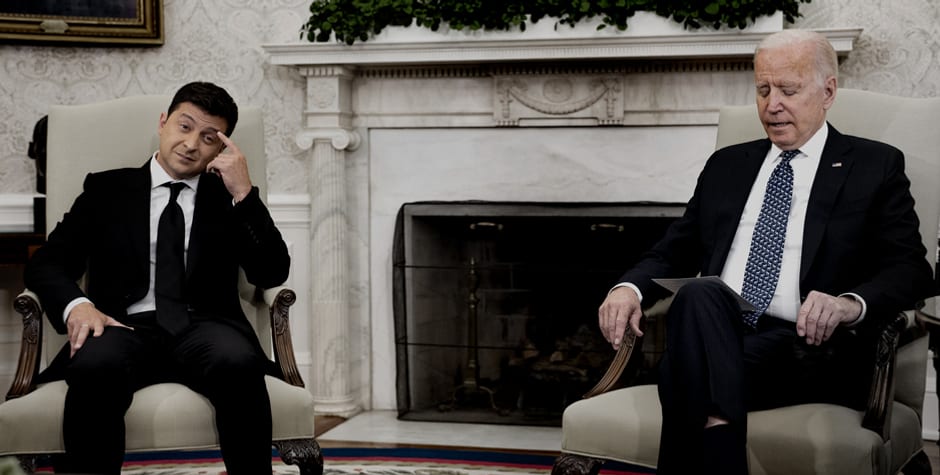
The Biden Administration's Steps and Missteps in Supporting Ukraine
The war in Ukraine rages on. Innocent civilians continue to be targeted by Russian forces in clear violation of the laws of war, otherwise known as International Humanitarian Law. The laws of war, sometimes called the Law of Armed Conflict, regulate the conditions for starting a war (jus ad bellum) and the behavior of the warring parties (jus in bello). The rules of war are universal; the Geneva Conventions form the basis of these rules and have been ratified by 196 nations. Without the rules of war, we all lose. Russia violated the just cause for starting a war and continues to violate the rules about how to conduct a war.
The West, led by the United States and NATO, have admirably stepped up in their support of Ukraine and the condemnation of Vladimir Putin and Russia. Gradually, more and more nations have offered weapons and other material support to Ukraine, which is in the fight of its life for sovereignty and security.
However, throughout this conflict, it often appears that President Biden follows more than he leads. His increased support of Ukraine and sanctions on Russia have been in response to pressure by Members of Congress and some of our NATO allies. It appears he constantly plays catch up. His words frequently lack clarity and consistency. His missteps began at the end of last year when he seemed to indicate that if Russia invaded Ukraine on a small scale—it would be tolerated. Some believe this was the beginning of Putin’s perception of tacit approval for invading a neighboring country. Biden then later called for regime change in Russia, which the White House had to immediately walk back. In speaking to U.S. troops deployed to Europe, he indicated that they would soon be serving in Ukraine, which necessitated another White House clarification.
In a New York Times editorial last week, Biden’s very title of his article illustrates part of the problem, President Biden: What America Will and Will Not Do in Ukraine. Over and over in the Ukrainian War, President Biden telegraphs to Vladimir Putin what actions we will take, and what things about which Vladimir Putin need not ever worry. This was just the latest example. He is the Commander-in-Chief. It is military leadership 101, on a strategic and tactical level, that you keep your enemy guessing. Unpredictability is key in keeping an adversary off balance. While there are true limits to what the U.S. will and will not do—you never reveal that to the opposing force. I am mystified that Biden continues to do this, and even more curious as to whether and why the Pentagon leadership believes this is acceptable. Why would the President inadvertently give Putin any reassurance?
With that said, the U.S. and our allies have thus far made wise decisions concerning Ukraine. The free world wants to help—and is helping. The commitment to not deploy any NATO troops to Ukraine is correct. Not using NATO aircraft to impose a no-fly zone is another smart decision. Ukraine must be given all the tools it needs to fight for its own freedom. But the fight must belong to the people of Ukraine.
Europe provided Russian-made aircraft to Ukraine, including M-17 helicopters, equipment that the Ukrainian military knows how to use. Some NATO countries have also supplied Ukraine with missile defense systems to counter Russian air attacks. We have supplied Javelin anti-tank missiles, Stinger anti-aircraft missiles, drones, and radar systems. Significantly, the U.S. has shipped some of our most advanced artillery weapons to Ukraine.
A few days ago, President Biden stated the U.S. would not send rocket systems that Ukraine could fire into Russia. One day later, he announced in his NYT op-ed that as part of a $700 million aid package, the U.S. would send an advanced rocket system to Ukraine after all—with the assurance from Ukraine that they would not fire them into Russia. To quote the Bible, “If the trumpet gives an uncertain sound, who shall prepare himself for battle?” (I Corinthians 14:8) It seems that on numerous topics, more uncertainty emanates from the Biden White House than anything else.
However, the HIMARS rocket system that the U.S. will now send to Ukraine is wise and much needed. The war in the Donbas region of Ukraine has become largely an artillery war. With the Russian ground assaults in Ukraine—and its logistical supply line—being an abject failure, Russian forces have resorted to the one thing at which they are effective: pounding the Ukrainians with artillery rounds and beating both Ukrainian troops and civilian population centers into dust. It has become a battle of cannons and rockets.
The 155 Howitzers supplied to Ukraine by the U.S. have an approximate range of 25 miles. Russian forces beyond that distance can fire effectively and indiscriminately at Ukrainian targets. The new systems we are providing will counter the Russian bombardment. The High Mobility Artillery Rocket System (HIMARS) is on wheels, not tracks, giving the Ukrainian artillery forces the ability to do what good artillerymen do: Shoot. Move. And communicate. Additionally, the HIMARS system, with the type of rounds we are supplying, has a range of almost 50 miles. This allows Ukrainians to track the incoming Russian rounds and execute deadly counter-battery fire. HIMARS is GPS guided and thus accurate, can be fired more rapidly than traditional artillery, and has high-explosive rounds—some as large as a 500-pound bomb which are generally dropped from aircraft. It is a great weapon system. The system can also use the traditional Multiple Launch Rocket System (MLRS).
War is a horrible thing. We continue to pray for peace. But evil must be confronted. If it is not, evil triumphs. In this case, it would allow Russia to redraw international borders at will and propose a potential threat to all of Europe, especially the members of NATO who were formerly a part of the Soviet Union or the Warsaw Pact. Inaction would allow the slaughter of civilians—innocent women and children included—to continue with impunity. This must not stand.
Support the work of the ACLJ as we continue to bring you expert analysis on the issues that matter most.