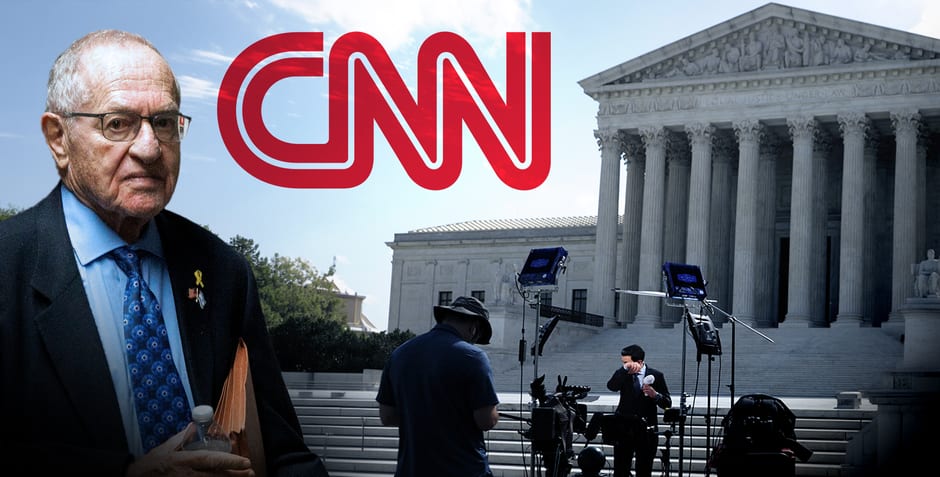
ACLJ Files Reply Brief to Supreme Court in Landmark Case Representing Professor Dershowitz Against CNN Over Defamation Involving Legal Defense of President Trump
Listen tothis article
When mainstream media outlets can falsely vilify, smear, and attack public figures with impunity, there is a fundamental problem in the law.
That’s exactly what’s at stake in our case representing Harvard Law School professor emeritus and famed constitutional lawyer Alan Dershowitz against CNN.
After we took this landmark case to the Supreme Court on behalf of Professor Dershowitz, and after the Supreme Court ordered CNN to respond to our petition, the network finally filed its brief in opposition. Now we’ve filed our reply – and it dismantles CNN’s arguments one by one.
As we previously explained:
On January 29, 2020, Professor Dershowitz – a distinguished Harvard Law School professor emeritus and practicing attorney – appeared on the Senate floor to defend the Constitution and establish why the Constitution would not authorize a conviction of President Trump. Professor Dershowitz served as part of a distinguished legal team, alongside White House Counsel Pat Cipollone, former Attorney General Pam Bondi, Jordan, and myself, among others.
In response to a question from Senator Ted Cruz (TX), Professor Dershowitz delivered a carefully crafted constitutional analysis that made critical distinctions about what conduct could and could not constitute an impeachable offense.
During the Senate trial, Professor Dershowitz was crystal clear: Actions motivated by personal financial gain – bribery, extortion, kickbacks – would absolutely remain impeachable offenses. However, as soon as he finished speaking, CNN went on air and told its audience the exact opposite. CNN commentators declared that under the “Dershowitz Doctrine,” bribery statutes were “gone” and a President could do virtually anything to get reelected, directly contradicting what he actually said.
Professor Dershowitz sued for defamation, and even the courts that ruled against him acknowledged he had been lied about – but determined that they were bound by a 62-year-old Supreme Court precedent called New York Times v. Sullivan. That’s why we took this case to the Supreme Court.
Here’s the bottom line: CNN cannot dispute the two most critical facts in this entire case. Professor Dershowitz never said a President could commit bribery or extortion without consequence. And CNN’s own commentators told millions of viewers that he had. As Judge Lagoa found, CNN “simply lied about what Dershowitz had said.” The district court agreed: Dershowitz “said nothing of the kind.” Those findings are not in dispute. What CNN is trying to do now is throw up procedural smokescreens to keep the Supreme Court from ever reaching the substance of what happened.
CNN is now trying to avoid the core issue by pointing to alternative legal theories – suggesting that state law would have barred the case anyway. But that’s not what the courts below decided; they never ruled on Florida law grounds, but on federal constitutional grounds alone. As Judge Lagoa made plain: “[T]he only thing standing between Dershowitz and justice” was Sullivan itself. CNN’s Florida law argument, taken to its logical conclusion, would mean this Court could never reconsider Sullivan – because every state has had no choice but to follow it. That cannot be right, and we told the Court exactly that.
In other words, CNN’s argument is not a real answer to what happened – it’s an attempt to keep the Supreme Court from addressing it.
Sullivan was decided in 1964 – when there were three TV networks and no internet. The media landscape has fundamentally changed. When courts can acknowledge defamation and still rule for the liar, the system is broken. As we’ve said from the beginning, the First Amendment was designed to prevent government censorship – not to give CNN a license to lie about private citizens with impunity.
But this case is about more than just one man’s reputation. It’s about whether the First Amendment protects robust debate or shields profitable falsehoods. And fundamentally, it’s about whether Americans still have the right to petition their government – including the courts – for redress when they’ve been wronged.
The Justices now have everything they need. The petition is fully briefed. We are asking the Court to grant certiorari, restore accountability to defamation law, hold the mainstream media accountable, and give Professor Dershowitz the jury trial he has always deserved.