Defending Religious Liberty – A Calling
I have spent my life’s work defending religious liberty and constitutional freedoms. It’s my passion – my calling. Recently, I was able to sit down with Matt Lewis of the Daily Caller to talk about what this fight has meant to me and about some of the victories we have achieved over the years.
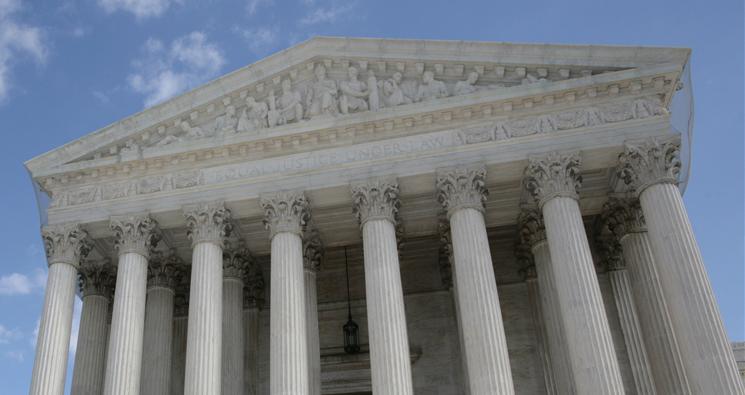
He asked me to talk about some of the most significant cases I have handled before the Supreme Court, and I wanted to share some of that interview with you.
Probably the most significant case of the last 30 years at that point, I’d say certainly—probably the last 40 years, was a case involving students who wanted to have a Bible club in high school. Now in today’s world, we think of that as a non-issue. They want to have a Bible club or religious club, what’s the problem? There are political clubs; you’re allowed to do these things. But back in the ‘80s, that wasn’t the case; and it actually took an act of Congress to authorize the law, and then that law was challenged in court. It ended up at the Supreme Court of the United States, and I argued that case in 1990s. But even before that case, we had cases involving free speech; so I had a series of Supreme Court cases; and as I said, the focus was primarily religious liberties in the early days, but it quickly expanded into the pro-life arena as well. By the late ‘80s/early 1990s, we were representing Operation Rescue. We had a series of major cases that were big news back in the late ‘80s and early ‘90s, and we had a series of cases at the Supreme Court dealing with that.
He also asked me to share why defending religious liberties has been so important to me, specifically he asked, “Was there something about being the grandson of an immigrant?”
Yes, I think it’s not just being the grandson of an immigrant; it was the grandson of an immigrant who left Russia because of religious persecution. My grandfather faced that persecution at the time of the Russian Revolution, as a lot of Jewish people did in 1914, ’15, ’16 and ’17; and he came to the United States as a 14 year old. When he came here, I have this statue in my office which is a model of Ellis Island because my grandfather came through Ellis Island. Actually, my son, Logan, found his immigration papers online, signed by my grandfather, who was naturalized in 1930 as a U.S. citizen. But he came here through Ellis Island, and I do think—I do this from a personal standpoint. When I argue those cases at the Supreme Court of the United States—and I say this with deep admiration for living in this country—when they call my name and they say, “Mr. Sekulow, we will now hear from you,” (which they’ve done over a dozen times now and I’ve had a lot of cases up there, obviously), I always think about that. Here I am, Mr. Sekulow, the grandson of a Russian immigrant who came through Ellis Island, and his grandson is arguing cases before the Supreme Court of the United States. So I think both as it relates to this whole idea of religious freedom, but liberty and freedom generally, I take very personally.
I have not only a deep affinity and affection for our country, but a desire to preserve and protect and defend it in the courtrooms, and within the context of the vision the Founding Fathers intended. That’s the motivating force for me in all of these cases that we’ve done, including the campaign finance cases, the religion cases, the statutory cases, that’s been a big part of who I am. I take that charge—you said it right, Matt—as the grandson of a Russian immigrant very seriously.
I was also able to share how this passion for defending religious liberty has led to the ACLJ’s expansion around the world and some of the critical work we are involved in worldwide.
Well, starting in 1997, so it’s been a long time, we were invited to speak with some lawyers in Europe and I realized very quickly that what was happening in Europe on critical issues involving life, involving religious freedom, were really at stake there. I was also concerned that I saw this growing phenomenon and this idea that they were going to take international law, because it had already started creeping in, and apply it to the U.S. Constitution despite the fact that Europe does not have a constitution. We thought it would be in our interest to litigate in Europe on issues of life and liberty and religious freedom with a clear understanding that the law determined there involves Europe and should not be placed on the United States even though the same principles were at stake. I thought that was dangerous. So I said, well, if establish a full office and operation—we initially opened in Strasbourg, France, which is where the European Court of Human Rights sits. Look, we know that there’s importance regarding law in Europe, but we also know this—we have an office over there—we don’t take European law which is not based on a constitution and apply it to the United States. Now that’s coming from lawyers who litigate in Europe and have offices in Europe with European lawyers running them. So, the idea was to address a lot of the same issues that were in a strictly European context and not mix the two. That’s what we really focused on. So, our first international office was there in Strasbourg, France.
I was also able to talk about my first case before the Supreme Court, Jews for Jesus, what goes in to preparing for an oral argument before the Supreme Court, and the newest case we have asked the Supreme Court to take involving at Ten Commandments display in a courtroom. I encourage you to listen to the interview and read the entire transcript, “Jay Sekulow says defending religious liberty is ‘personal.’”