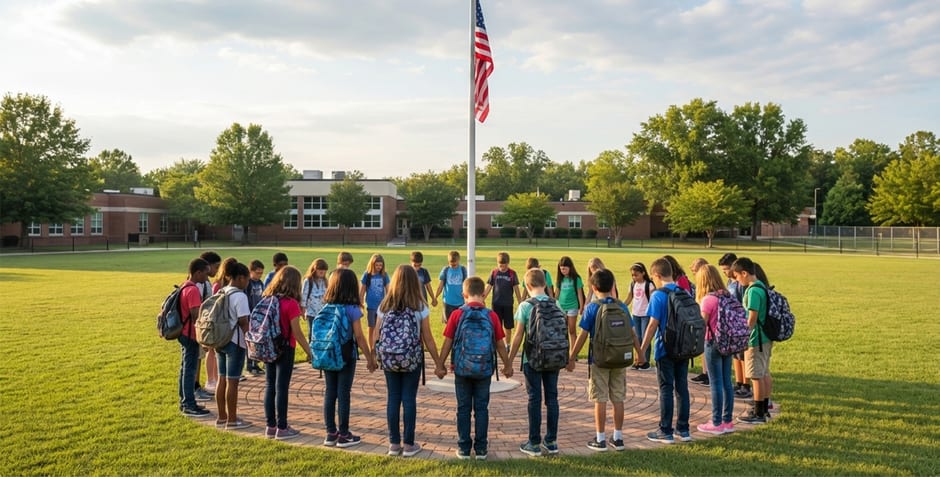
See You at the Pole: Largest Global Student Prayer Event
In 2026, See You at the Pole – the student prayer event – is set to take place at schools around the country on Wednesday, September 23. The ACLJ has prepared an informational letter answering frequently asked questions regarding student, teacher, and parent participation in See You at the Pole events.
See You at the Pole is a student-led prayer movement in which students pray together, usually before school starts, at the school’s flagpole. The First Amendment and the Equal Access Act ensure that public schools must allow student-led prayer on the same basis that other student speech is permitted on campus. Tinker v. Des Moines Indep. Community Sch. Dist., 393 U.S. 503 (1969); Bd. of Educ. v. Mergens, 496 U.S. 226 (1990). As long as the student conduct does not materially or substantially interfere with school discipline, a student may gather with other students on campus for prayer even if no Bible Club has been officially recognized. See Tinker, 393 U.S. at 504.
Moreover, the United States Department of Education’s Guidance on Constitutionally Protected Prayer in Public Elementary and Secondary Schools, with which public schools must comply to continue receiving certain federal funding, provides further protection for gatherings like See You at the Pole:
Students may organize prayer groups and religious clubs to the same extent that students are permitted to organize other noncurricular student activity groups. Such groups must be given the same access to school facilities for assembling as is given to other noncurricular groups, without discrimination because of the groups’ religious character or perspective. . . . Schools may take reasonable steps to ensure that students are not pressured to participate (or not to participate) in such religious activities. School authorities possess substantial discretion concerning whether to permit the use of school media for student advertising or announcements regarding noncurricular activities. However, where student groups that meet for nonreligious activities are permitted to advertise or announce their meetings—for example, by advertising in a student newspaper, making announcements on a student activities bulletin board or public address system, or handing out leaflets—school authorities may not discriminate against groups that meet to engage in religious expression such as prayer. School authorities may choose to issue appropriate, neutral disclaimers of the school’s sponsorship or approval of noncurricular groups and events.
Likewise, under the U.S. Department of Education’s Guidance, students have the right to wear Christian T-shirts, bring Bibles, and pass out pamphlets and tracts about Christ at See You at the Pole events. While schools may impose reasonable regulations that govern the time, place, and manner of student activities, such regulations may not target religious literature for more permissive or more restrictive regulation.
While teachers, like their students, do not “shed their constitutional rights . . . at the schoolhouse gate,” they do represent the school when in the classroom or at school-sponsored events and, therefore, should take care to avoid Establishment Clause violations. Tinker, 393 U.S. at 506. The U.S. Department of Education’s Guidance addresses the position that teachers and administrators should take:
When teachers, coaches, and other public school officials speak in their official capacities, they may not engage in prayer or promote religious views. . . . However, not everything that a public school teacher, coach, or other official says in the workplace constitutes governmental speech, and schools have less leeway to regulate employees’ genuinely private expression. To be sure, a public school, like any other governmental employer, may reasonably restrict its employees’ private speech in the workplace where that speech may have a detrimental effect on close working relationships, impede the performance of the speaker’s duties, or otherwise interfere with the regular operation of the enterprise.[See Kennedy v. Bremerton Sch. Dist., 142 S. Ct. at 2423-24; Rankin v. McPherson, 483 U.S. 378, 388 (1987); Pickering v. Bd. of Educ., 391 U.S. 563, 568-73 (1968).] In contexts where a school permits teachers, coaches, and other employees to engage in personal speech, however, it may not prohibit those employees from engaging in prayer merely because it is religious or because some observers, including students, might misperceive the school as endorsing that expression.[Kennedy, 142 S. Ct. at 2426-28.] (Emphasis added.)
Thus, teachers may not actively participate in or lead a student religious meeting in their capacity as school officials, but they may be able to participate in prayer events that occur during non-contract time, so long as they make it clear that they are present in their roles as citizens rather than in their official capacities. Kennedy, 142 S. Ct. 2407, 2425.
Parents and other adults should be allowed to participate in See You at the Pole events to the same extent that adults may attend on-campus events held by other student groups. However, as schools are usually granted broad discretion to enforce school visitor policies so long as they do not discriminate on the basis of religion, parents should be sure to become familiar with and comply with those school policies Thus, due to the early hour of See You at the Pole, parents may need to notify school officials of their planned participation ahead of time.
The American Center for Law and Justice (ACLJ) has played a pivotal role in safeguarding the religious liberties of public school students, their families, and educators. For decades, ACLJ attorneys have successfully litigated numerous cases in which school officials, whether through misunderstanding or opposition, have infringed upon the First Amendment rights of those in public education.
At present, the ACLJ is representing Staci Barber, a math teacher in Katy, Texas, whose First Amendment rights were infringed on when she wanted to pray on campus, during her own time, in what she believed was a private moment. Ms. Barber was informed by her principal that she was prohibited from praying anywhere on school grounds where students could observe her. When she sought to participate in the See You at the Pole event by praying at the school’s flagpole before the school day commenced, Principal Bryan Scott Rounds issued a sweeping directive: Staff members “CANNOT pray with or in the presence of students,” not only during this event but at any location on campus where students might potentially witness such activity.
In March 2024, the ACLJ filed suit to defend Ms. Barber’s constitutional rights, achieving a crucial victory when District Judge Alfred H. Bennett denied the principal’s motion to dismiss. The court decisively ruled that the school’s actions violated clearly established First Amendment protections, referencing the landmark Supreme Court decision in Kennedy v. Bremerton School District. Refusing to accept this outcome, Principal Rounds appealed, and the case now stands before the Fifth Circuit. The court’s decision will not only determine whether school officials may categorically suppress visible religious expression by educators but will also set a powerful precedent for how religious liberty is understood and protected in American schools.
On January 9, the ACLJ presented oral arguments before the United States Court of Appeals for the Fifth Circuit. This case holds national significance: Its outcome will help define the boundaries of permissible religious expression for public school teachers, not only within the Fifth Circuit but potentially across the United States. Educators deserve assurance that wearing a cross necklace, offering a quiet prayer over lunch, or engaging in other sincere expressions of faith will not imperil their livelihood.
We invite students, teachers, and parents to share our See You at the Pole letter with school officials. We also encourage you to contact us by filling out our legal help request form online should you have any issues holding a See You at the Pole event at your school.