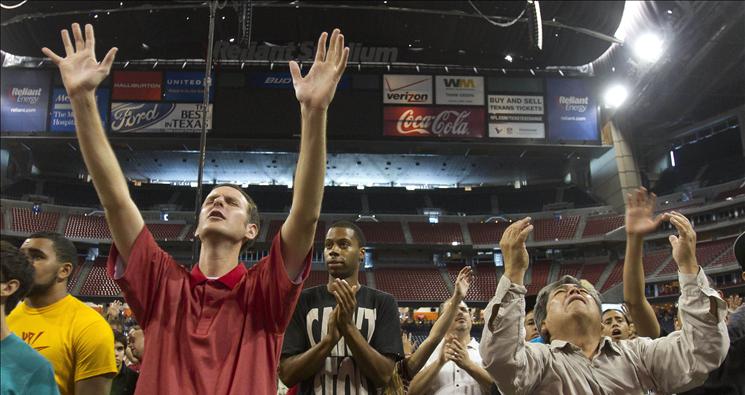
The Response and the Power of Faithful Prayer
Prayer is essential. Faith is powerful. Non-believers and skeptics cannot comprehend the concept of literally asking God for His guidance and blessing. This is not surprising nor is it, in itself, offensive. When the lack of understanding turns into sneers and insults, usually coupled with a lack of basic knowledge about the evangelical Christian faith, we have a duty to respond.
This is my response to a particular column written by Frank Bruni of the New York Times about The Response: A Call to Prayer for a Nation in Crisis, a recent nonpolitical gathering initiated by Texas Governor Rick Perry (who, by the way, asked the crowd to pray for President Obama).
I am writing this because I am a Christian, not because I am a conservative.
In “True Believers, All of Us, ” Bruni writes that, “Seeking relief from the country’s woes through a louder, more ardent appeal to God strikes us [the news media] as too much hope invested in too magical a solution. It suspends disbelief and defies rigorous reason.”
Yet, this kind of appeal to God is exactly what we are instructed to do, especially in a time of crisis. The Book of Joel, in the portion read by Governor Perry, tells us to:
Blow the trumpet in Zion, declare a holy fast, call a sacred assembly. Gather the people, consecrate the assembly; bring together the elders, gather the children, those nursing at the breast. Let the bridegroom leave his room and the bride her chamber. Let the priests, who minister before the LORD, weep between the portico and altar. Let them say, “Spare your people, LORD. Do not make your inheritance an object of scorn, a byword among the nations. Why should they say among the peoples, ‘Where is their God?’” Then the LORD was jealous for his land and took pity on his people.
Jesus affirmed the power of assembly, teaching that, “where two or three gather in my name, there am I with them.”
Bruni does not understand prayer, thinks that it is a waste of time, and implies that those of us who take prayer seriously are foolish. Here you might be asking, “Well Jordan, why all the fuss? Isn’t this what we have learned to expect from a liberal-leaning columnist?”
Yes, but Bruni did not stop there. He steps up his assault on faith and prayer in the last paragraph of the column:
And right now, with the stock market floundering and our credit rating downgraded and millions of Americans stranded in unemployment and Washington frozen in confusion, the temptation to look for one summary prescriptive - for certainty, even miracles - is strong. We’d be wise to resist it. To get us out of this mess, we need a full range of extant remedies, a tireless search for new ones and the nimbleness and open-mindedness to evaluate progress dispassionately and adapt our strategy accordingly. Faith and prayer just won’t cut it. In fact, they’ll get in the way.
This is where Bruni completely misrepresents Christian faith and Christian prayer. While he admits that, “we journalists become triply fascinated [with evangelicals] whenever the Republican primaries roll around,” he implies that those evangelicals are praying for divine intervening and doing nothing else.
Journalists like Bruni are fascinated with evangelicals around election season because we play such an active role in American politics. Bruni may not like our philosophy on government but the sheer fact that we are so politically engaged disproves his “faith and prayer just won’t cut it” line. He’s upset because we refuse to “cut it” the way he wants.
Maybe Bruni never read in the Bible that, “Faith by itself, if it does not have works, is dead.” That, however, is not an excuse for Bruni. Anyone with a functioning brain can quickly survey American politics and find that evangelicals have become a grassroots force, members of Congress, and president of the United States (Bruni actually covered President Bush’s, an evangelical, first campaign and wrote a book about it). That does not happen by prayer alone but by putting our faith into action.
As C.S. Lewis noted in Mere Christianity, “even those [Christians] who insist most strongly on the importance of good actions tell you [that] you need faith; and even those who insist most strongly on faith tell you to do good actions.”
The Christians who gathered at The Response are not sitting back and waiting for some magical miracle. Yes, we believe in divine intervention but we also believe that we have a responsibility to utilize every opportunity the American system of government offers its citizens, particularly the robust political rights.
Unfortunately for Bruni, our prayers are working.
This article is crossposted at Jordan's Washington Post On Faith blog. Please keep the conversation going by registering to comment on the Washington Post site to engage this debate about the power of prayer.