President Trump Urging Arab Nations To Take In Palestinian Refugees of Hamas’ War Is Lawful and Encouraged Under Human Rights Law
Listen tothis article
In light of the massive humanitarian crisis caused by Hamas’ vile terrorist attacks on Israel and Israel’s necessary self-defensive measures to root out the terrorists, President Trump has suggested the surrounding Arab nations take in Palestinian refugees to assist in the humanitarian crisis. Over 100,000 Palestinians have already fled Gaza and have been taken in by other nations. Yet, in response to President Trump’s statement, the Left has overreacted, once again fearmongering that President Trump is somehow violating international law. He is not.
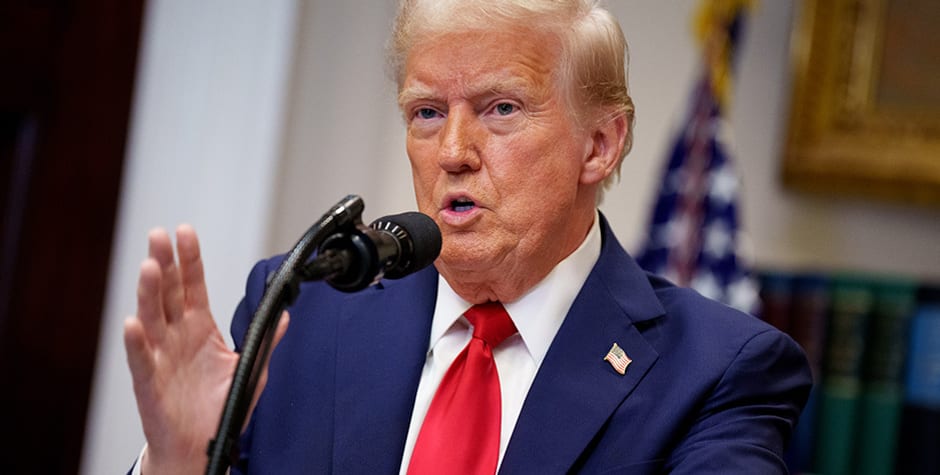
Answering reporters’ questions on January 25, 2025, regarding Palestinian refugees, President Trump said, “I’d like Egypt to take people, and I’d like Jordan to take people. . . . You’re talking about probably a million and a half people, we just clean out that whole thing.” He further said it “could be temporary or long term. . . . It’s . . . a demolition site right now. Almost everything’s demolished, and people are dying there. . . . So, I’d rather get involved with some of the Arab nations, and build housing in a different location, where they can maybe live in peace for a change.”
In response, Omar Shakir, the Israel and Palestine Director at Human Rights Watch, said that Trump’s proposal “would amount to an alarming escalation in the ethnic cleansing of the Palestinian people and exponentially increase their suffering.” Such comments are irresponsible since President Trump said nothing about forcibly transferring Palestinians against their will to the neighboring Arab countries.
The legality of such a move, if implemented, depends on whether Palestinians are forcibly transferred, which is prohibited under the Law of Armed Conflict (LOAC), or rather resettled for their protection as a humanitarian measure, which is not only lawful but encouraged under human rights law.
Under the LOAC, “Parties to an international armed conflict may not deport or forcibly transfer the civilian population of an occupied territory, in whole or in part, unless the security of the civilians involved or imperative military reasons so demand.” The same rule, with a slight variation, applies to a non-international armed conflict. Further, forcible transfer or displacement of a civilian population would only constitute ethnic cleansing if such action “aim[ed] to change the demographic composition of a territory.”
However, even an act of forced removal, when carried out for the security of the civilian population or for imperative military reasons, “cannot constitute actus reus of deportation or forcible transfer” as long as such reasons are not used as a pretext.
On the other hand, international human rights law provides refugees with the option of voluntary resettlement. The United Nations High Commissioner for Refugees (UNHCR) defines “resettlement as the selection and transfer of refugees from a State in which they have sought protection to a third State that has agreed to admit them – as refugees – with permanent residence status.”
An Arab country may, for example, accept President Trump’s proposal to temporarily or permanently accept Palestinian refugees who are voluntarily seeking protection and resettlement. In fact, such a decision should be applauded as lawful humanitarian action. Only forcible transfer of the Palestinian population against their will without a genuine choice would constitute a war crime.
Of note, in international law, “force” is not limited to physical force but includes “the threat of force or coercion, such as that caused by fear of violence, duress, detention, psychological oppression or abuse of power, or taking advantage of a coercive environment. It is the absence of genuine choice that makes the displacement unlawful.” Further, “[w]hile [the] fear of violence, use of force, or other such circumstances may create an environment where there is no choice but to leave, the determination as to whether a transferred person had a genuine choice is one to be made in the context of a particular case being considered.”
Here, the displacement – caused by Hamas – has already happened. President Trump’s proposal was to provide those already displaced Palestinians with safe housing.
By August 5, 2024, more than 100,000 Palestinians had crossed the border into Egypt since October 7, 2023. At least 11 other countries have accepted refugees from Gaza since October 7. Australia has taken 2,922. Belgium granted refugee status to 1,433 Palestinians between January and July 2024. The U.K. approved 145 asylum applications by Palestinians between October 2023 and June 2024. In this regard, neither the accepting countries nor the countries that may have encouraged the accepting countries to take those refugees acted unlawfully.
Many in the international community, including the U.N., the ICC, and Palestinian leaders, may wrongly label President Trump’s idea as “ethnic cleansing” as resettlement of Palestinians could negatively impact the idea of a “Palestinian state.” Despite such politically charged language, the President may lawfully encourage other states to assist with Palestinian refugees who are freely choosing resettlement.
Notably, all non-Palestinian refugees are governed by the UNHCR under the Refugee Convention, which strives to resettle refugees in third countries. Unfortunately, the UNRWA, which handles only Palestinian refugees, has been perpetuating the Palestinian refugee problem since its creation as it has no mandate for resettling the Palestinian refugees.
As a result, even third- and fourth-generation descendants of Palestinian refugees who fled to Jordan in 1948, for example, are still considered refugees even though many of them have Jordanian passports. In short, President Trump’s suggestion to “resettle” (as opposed to forcibly transfer) Palestinian refugees goes against UNRWA’s very modus operandi to perpetuate the Palestinian refugee crises.
For President Trump’s proposal to be unlawful, he must have the intent to forcibly displace the Palestinian population without a lawful security or military-related reason. Any humanitarian effort toward the voluntary resettlement of Palestinians for their safety is not only lawful but applaudable.